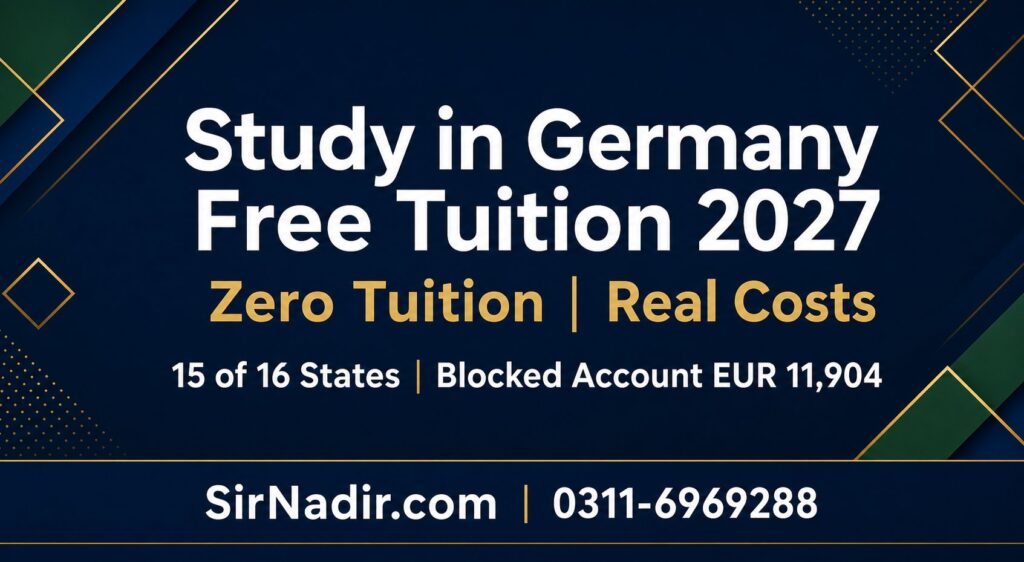


Is study in Germany really free? Yes — and unlike most “free education” claims online, this one survives scrutiny. Public universities in 15 of Germany’s 16 federal states charge zero tuition to international students, at bachelor’s, master’s and doctoral level. You pay only a small semester contribution. But “free” has exceptions, hidden costs, and a blocked-account requirement that catches applicants out. This guide gives you the honest numbers.
Where Tuition Is Actually Zero
| Where | Who pays | Amount |
|---|---|---|
| Public universities in 15 states | Nobody — all nationalities | €0 tuition (semester contribution only) |
| Baden-Württemberg (Heidelberg, KIT, Stuttgart, Freiburg, Tübingen, Mannheim) | Non-EU students | €1,500 per semester |
| Baden-Württemberg, second degree | Anyone taking a second bachelor’s or master’s | €650 per semester |
| TUM Munich | Non-EU students first enrolled from winter 2024/25 | €2,000–€3,000/semester (bachelor’s), €4,000–€6,000 (master’s) |
| Private universities | Everyone | €10,000+ per year |
Doctoral students are exempt from the Baden-Württemberg fee. Bavaria lets individual institutions decide, so Munich’s public universities vary from the rest of the state.
What the Semester Contribution Covers
Every student pays a Semesterbeitrag, typically €150–€400. It usually includes:
- Student services and administrative fee
- Public transport ticket (often statewide, not just city-wide)
- Student union / body fee
Real examples for perspective: LMU Munich: €97 (no transit pass currently), RWTH Aachen: €375, University of Hamburg: €402, Leibniz Hannover: €453. The transport pass alone can make a €400 contribution better value than a €97 one.
What a “Free” Year Really Costs
| Item | Amount |
|---|---|
| Tuition | €0 (public university, 15 states) |
| Blocked account (visa proof of funds) | €11,904 — about €992 per month |
| Semester contributions (2 semesters) | €194–€906 |
| Health insurance | €110–€150 per month |
| Rent | €300–€700 per month depending on city |
| uni-assist application | From €75, plus €30 per additional programme |
| National visa fee | €75 |
The blocked account is the real hurdle — you must show €11,904 before the visa is granted. That is living money, released to you monthly, but it has to exist up front.
Do You Need German?
Not always — but this is the most important decision you will make.
- German-taught programmes: the vast majority at bachelor’s level. Usually require B2/C1 German, proven by DSH, TestDaF or a recognised certificate. Free tuition, but you need the language.
- English-taught programmes: far more common at master’s level. Usually require IELTS 6.0–6.5 or TOEFL 80–90. Small or no tuition, but in English.
- Bachelor’s in English: limited options, mostly at private universities or specific public programmes. Check each one individually.
Admission Requirements
- Recognised secondary qualification — for many non-EU applicants, a 12-year school certificate alone is not sufficient. A Studienkolleg (one-year preparatory course) or completed first year at a recognised university may be required.
- Language certificate — DSH/TestDaF for German-taught, IELTS/TOEFL for English-taught.
- APS certificate — required for applicants from certain countries including China, India, Vietnam and Pakistan, depending on current rules. This takes time and must be planned early.
- uni-assist — many universities route international applications through this service, which charges a fee.
- Motivation letter and CV for many master’s programmes.
Working While Studying
- International students can generally work around 20 hours per week during term.
- Typical student wage: €13–€16 per hour.
- This does not replace the blocked account — it supplements it after arrival.
Blocked Account vs Scholarship
Many students confuse the two. The blocked account is proof of funds, not funding — it is your own money, returned to you in monthly instalments. A scholarship replaces or reduces the amount you must show. If you are relying on a scholarship, confirm whether it is recognised for the blocked-account requirement before applying.
Step-by-Step Application
- Choose German-taught or English-taught — this decides your language preparation path.
- Check your school certificate’s recognition — you may need Studienkolleg.
- Apply for APS if required for your country — start months in advance.
- Shortlist programmes on DAAD and university websites, noting deadlines (many have two intakes).
- Apply through uni-assist or directly, paying the applicable fee.
- Receive your admission letter (Zulassung).
- Open a blocked account with €11,904 and arrange health insurance.
- Apply for the national visa at the German embassy with the full document set.
- Arrive, register your address, enrol, and pay the semester contribution.
Mistakes That Cost Students a Year
- Assuming every public university is free. Baden-Württemberg and TUM charge non-EU students.
- Ignoring the blocked account. Without €11,904 you cannot get the visa, regardless of zero tuition.
- Applying with an unrecognised school certificate. Check recognition before doing anything else.
- Missing the APS requirement. It takes weeks and blocks the whole application.
- Choosing German-taught programmes without German. Free tuition is worthless if you cannot follow lectures.
- Forgetting uni-assist fees. Budget €75 plus €30 per additional programme.
Frequently Asked Questions
Is studying in Germany really free for international students?
Yes, at public universities in 15 of 16 states, for bachelor’s and consecutive master’s degrees, with only a €150–€400 semester contribution. The exceptions are Baden-Württemberg (€1,500 per semester for non-EU) and TUM Munich (fees for non-EU students from winter 2024/25).
How much money do I need for the visa?
A blocked account of €11,904, which releases about €992 per month to you after arrival.
Can I study in Germany in English?
Yes, mainly at master’s level. English-taught bachelor’s programmes are limited. Check each programme’s language requirement.
Do I need to learn German?
Only if your programme is German-taught, which most bachelor’s programmes are. English-taught master’s programmes usually require IELTS 6.0–6.5 instead.
Is the semester contribution worth it?
Usually yes — it typically includes a public transport pass that can be worth more than the fee itself, especially in states with a statewide ticket.
Can I work while studying?
Generally up to around 20 hours per week during term, at roughly €13–€16 per hour. This supplements but does not replace the blocked account.
Related Posts on SirNadir.com
- Study in UK Without IELTS 2027
- Study in Canada Without IELTS 2027
- Study in Australia Without IELTS 2027
- IELTS Band Score Guide 2026
Last reviewed: 23 October 2026 by SirNadir.com editorial team. Tuition policies, semester contributions and blocked-account amounts change by state and by year. Always verify on DAAD, the university’s own page and the German embassy website.