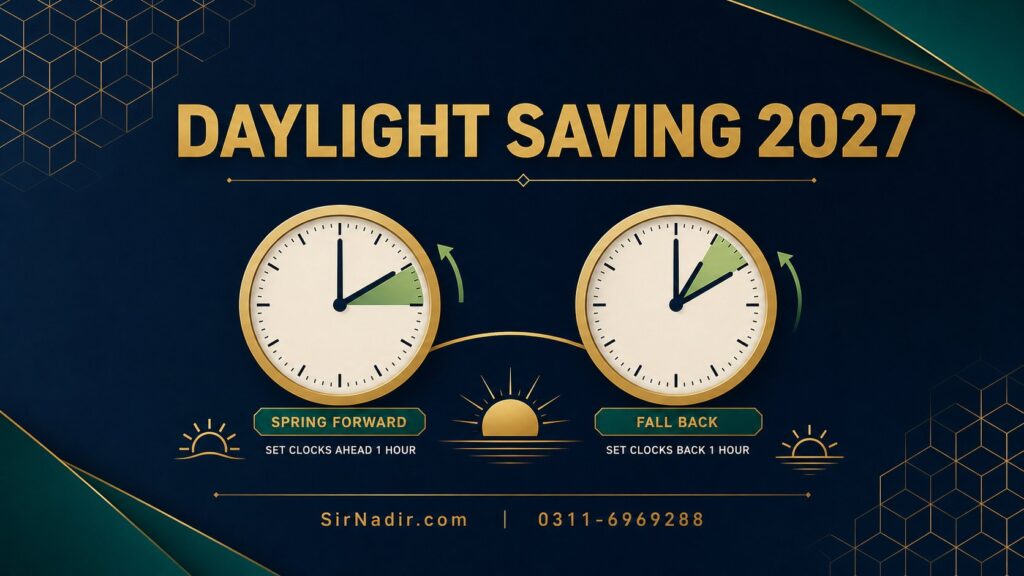


In 2027, clocks in most of the United States move forward one hour on Sunday 14 March at 2:00 a.m. and back one hour on Sunday 7 November at 2:00 a.m. Those are the two dates, and they are set by federal statute — the Uniform Time Act of 1966 as amended by the Energy Policy Act of 2005.
This guide gives the 2027 dates, the states and territories that do not change at all, what happened to the Sunshine Protection Act, and the practical consequences people get wrong every year — from flights and payroll to medical devices and court deadlines.
2027 Daylight Saving Time Dates
| Change | Date | What happens at 2:00 a.m. | Hours of daylight |
|---|---|---|---|
| Spring forward | Sunday 14 March 2027 | 2:00 a.m. becomes 3:00 a.m. — one hour is skipped | Evenings get one hour longer |
| Fall back | Sunday 7 November 2027 | 2:00 a.m. becomes 1:00 a.m. — the 1 a.m. hour happens twice | Mornings get one hour brighter |
The rule is fixed: DST begins on the second Sunday in March and ends on the first Sunday in November. In 2027 the second Sunday falls on 14 March — the latest possible date — and the first Sunday in November falls on 7 November — also the latest possible date.
Who Does Not Change the Clocks
Not everyone in the United States observes daylight saving time. These places stay on standard time all year:
- Arizona — except the Navajo Nation, which does change.
- Hawaii — no DST at any point in the year.
- Puerto Rico, Guam, American Samoa, the US Virgin Islands and the Northern Mariana Islands.
Nineteen states have passed laws or resolutions supporting permanent daylight saving time, but none can act without a change in federal law. Until Congress acts, those state laws are dormant.
What Happened to the Sunshine Protection Act
| Date | Event |
|---|---|
| 14 July 2026 | US House passes the Sunshine Protection Act (H.R. 139) by 308–117 |
| August 2026 | President publicly urges the Senate to pass it |
| As of 25 October 2026 | Senate has not voted; the bill is not law |
| 1 November 2026 | Clocks fall back as scheduled under existing law |
Five Things That Break on Clock-Change Weekend
- Flights booked across the change. A 1:30 a.m. departure from a DST-observing airport does not exist on 14 March, and the same clock time repeats twice on 7 November. Airlines reschedule these silently — check your booking a week before.
- Payroll for hourly workers. In November, an overnight shift can contain an extra real hour. Most employers pay it; confirm the policy, because not all do.
- Medical devices and medication schedules. Insulin pumps, continuous glucose monitors and 12-hour medication cycles should follow the clock, not the absolute time. Ask your clinician about overnight doses.
- Court, filing and contract deadlines expressed in “local time”. An 11 p.m. filing on 7 November is unambiguous; a filing “at 1:30 a.m.” is not.
- Server logs and timestamps. Systems logging in local time show a one-hour gap in March and a duplicated hour in November. This matters for anyone reconciling audit trails.
Health Effects — What the Evidence Says
Research on the spring transition consistently finds a small but measurable rise in heart attacks, strokes and traffic incidents in the days afterwards, linked to sleep loss and disrupted circadian rhythm. The effect is strongest in the first two to three days.
Practical mitigation is unglamorous but works:
- Shift bedtime 15 to 20 minutes earlier for the four nights before 14 March.
- Get bright outdoor light early in the morning on the Sunday and Monday.
- Avoid alcohol on the Saturday night and do not plan a long drive on the Sunday.
- For the November change, the risk is lower, but the darker evenings affect mood and driving visibility.
Which Holiday and Benefit Dates Are Affected
Daylight saving time does not move federal holidays or payment dates — but it does change how late the sun sets during them. In 2027 the changes interact like this:
- Memorial Day, 31 May 2027 falls in DST, so it is a long, light evening.
- Independence Day, observed Monday 5 July 2027 is close to the longest days of the year — sunset in most US cities is after 8:30 p.m.
- Veterans Day, 11 November 2027 falls after the clocks go back, so it is dark by late afternoon.
- Thanksgiving, 25 November 2027 is also after the change.
Our federal holidays 2027 guide lists all eleven dates, and the SSDI payment dates 2027 calendar shows the Wednesday schedule for disability benefits.
Frequently Asked Questions
When does daylight saving time start in 2027?
Sunday 14 March 2027 at 2:00 a.m. local time. Clocks move forward one hour to 3:00 a.m.
When does it end in 2027?
Sunday 7 November 2027 at 2:00 a.m. local daylight time. Clocks move back one hour to 1:00 a.m.
Is 2027 the last year of clock changes?
No law has been passed to end them. The Sunshine Protection Act cleared the House in July 2026 but has not passed the Senate, so the 2027 changes proceed as scheduled.
Which states do not observe daylight saving time?
Arizona (except the Navajo Nation), Hawaii, and the US territories of Puerto Rico, Guam, American Samoa, the US Virgin Islands and the Northern Mariana Islands.
Do I gain or lose an hour in March?
You lose one hour of time — the day is 23 hours long — but you gain an hour of evening daylight.
Does daylight saving time affect my Social Security or SSI payment date?
No. Federal benefit dates depend on the calendar and, for SSDI and retirement, on the weekday. The clock change has no effect.
Bottom Line
14 March 2027 — clocks forward. 7 November 2027 — clocks back. Arizona, Hawaii and the US territories stay put. No federal law has changed the rule, whatever you read about the Sunshine Protection Act. Set a reminder for the Saturday night before each date, and if you have overnight travel, medication or payroll on those weekends, check the details a week early rather than the morning of.