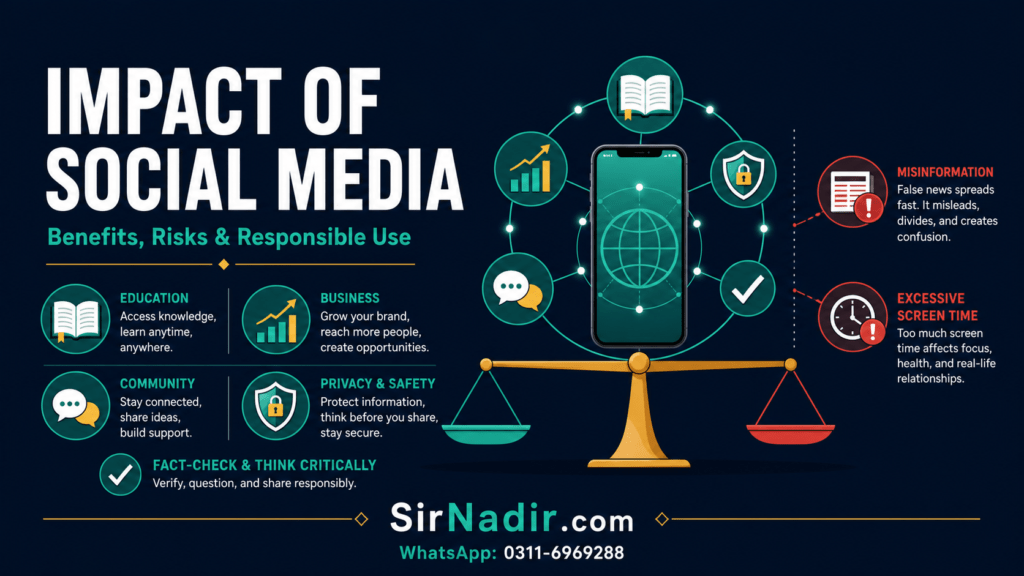


The impact of social media on society is both positive and negative. It has made communication, learning, business and public participation easier, but careless or excessive use can also harm privacy, attention, mental well-being and trust in information. This essay presents a balanced discussion suitable for secondary-school examination preparation.
Outline
- Introduction
- A revolution in communication
- Benefits for education and skills
- Business, employment and creativity
- Public awareness and civic participation
- Misinformation and online manipulation
- Mental well-being and unhealthy comparison
- Privacy, cyberbullying and digital footprints
- Effects on relationships and productivity
- Responsible use by individuals and institutions
- Conclusion
Essay: The Impact of Social Media on Society
Social media is one of the most influential technologies of the modern age. Through online platforms, people can create content, exchange ideas and communicate across geographical boundaries within seconds. A student can attend a lesson from another city, a small shop can display its products to thousands of customers, and a family can remain connected despite living in different countries. However, the same speed and reach can spread false information, expose personal data and encourage unhealthy habits. Social media is therefore neither entirely beneficial nor entirely harmful; its impact depends largely on how platforms are designed and how responsibly people use them.
Its most visible contribution is faster communication. In the past, sharing news across long distances required considerable time and expense. Today, text messages, voice notes, photographs and video calls allow immediate contact. Communities can organize help during an emergency, institutions can issue timely notices, and people can maintain friendships over distance. Social platforms also give users an opportunity to join communities based on education, profession, language or common interests. For people who feel isolated in their immediate surroundings, a supportive online community may provide useful advice and a sense of belonging.
Education has also benefited from social media. Teachers share lectures, diagrams, reading material and revision tips, while learners can discuss difficult concepts with classmates. Educational channels make explanations available beyond the classroom, often in local languages. Students can discover scholarships, competitions, career guidance and free courses. Social media can also develop communication, research and digital-production skills when learners create presentations, podcasts or informative videos. Nevertheless, not every popular post is accurate. Educational use must therefore include source checking, comparison with textbooks and consultation with qualified teachers.
Social media has transformed business and employment. Large companies use it for customer service, advertising and market research, while small businesses can reach customers without paying for a traditional shop or expensive media campaign. Writers, designers, tutors and craftspeople can present their work directly to potential clients. Professional networks may help job seekers learn about vacancies and build useful contacts. At the same time, online success is uncertain, algorithms can change, and dishonest advertisements can mislead consumers. Digital enterprise should be supported by truthful marketing, secure payment methods and respect for consumer rights.
Another important benefit is the rapid spread of public awareness. Campaigns about health, education, disaster relief, environmental protection and social welfare can reach large audiences. Citizens can report local problems, discuss public decisions and raise funds for genuine causes. Voices that receive little attention in traditional media may find an audience online. Yet popularity is not the same as truth or expertise. Complex issues are sometimes reduced to emotional slogans, and public pressure may be based on incomplete evidence. Healthy civic participation requires patience, context and respect for lawful processes.
Misinformation is among the greatest dangers of social media. A false claim can be copied thousands of times before a correction reaches the same audience. Edited images, misleading headlines, impersonation and fabricated quotations can create fear or damage reputations. Recommendation systems may repeatedly show users content similar to what they already believe, producing an “echo chamber” in which opposing evidence is ignored. Responsible users should read beyond headlines, examine the date and original source, distinguish opinion from reporting, and verify important claims through reliable institutions or multiple credible sources before forwarding them.
The relationship between social media and mental well-being is also complicated. Online communication can offer friendship, entertainment and emotional support. However, endless scrolling, pressure to gain approval and repeated exposure to carefully edited lifestyles may encourage anxiety, dissatisfaction or unhealthy comparison. Notifications can interrupt study and sleep, while fear of missing out can make users check their phones repeatedly. Not every user is affected in the same way, so sweeping claims should be avoided. Still, people should notice how particular habits affect their mood, concentration and daily routine, and seek help from a trusted adult or qualified professional when distress becomes persistent.
Privacy and safety present further concerns. Users sometimes publish their location, school, travel plans or personal documents without considering who may see them. Data shared today can form a lasting digital footprint and may later affect education, employment or personal relationships. Weak passwords, suspicious links and fake profiles increase the risk of fraud or account theft. Cyberbullying can be especially damaging because humiliating content can remain visible and spread quickly. Strong unique passwords, two-step verification, limited location sharing, careful privacy settings and prompt reporting of abuse are practical safeguards.
Social media has changed relationships as well. It helps relatives and friends stay in touch, but online contact should not completely replace face-to-face conversation. A family may sit together while each member focuses on a separate screen. Misunderstandings also occur because short messages lack tone and context. Similarly, frequent interruptions can reduce productivity at school and work. Setting phone-free periods during meals, study and sleep can protect attention and strengthen real-world relationships.
The solution is not to reject technology but to develop responsible digital citizenship. Individuals should set reasonable time limits, follow accounts that add genuine value, pause before posting and treat others with dignity. Parents can guide children through open discussion instead of relying only on punishment or secret monitoring. Schools should teach media literacy, online safety, respectful communication and proper citation. Technology companies should provide understandable privacy controls, effective reporting systems and age-appropriate protections. Governments can enforce fair laws against fraud, harassment and unlawful data use while respecting legitimate expression and access to information.
In conclusion, social media has reshaped communication, education, commerce and civic life. It can connect communities, spread knowledge and create opportunities, but it can also amplify falsehood, distraction, abuse and insecurity. The technology itself does not determine the final result. Human choices, digital skills, platform policies and social values all matter. When people verify information, protect privacy, manage screen time and communicate respectfully, social media can serve society rather than control it. Balanced and informed use is the best path toward gaining its benefits while reducing its risks.
Key Points for Revision
- Main benefits: rapid communication, educational access, business opportunities, creativity and public awareness.
- Main risks: misinformation, privacy loss, cyberbullying, distraction, unhealthy comparison and weakened face-to-face interaction.
- Best response: digital literacy, fact-checking, privacy protection, balanced screen time and respectful behaviour.
- Central argument: social media is a powerful tool whose effects depend on design, context and responsible use.
Useful Vocabulary
- Digital footprint: the lasting record created by a person’s online activity.
- Misinformation: false or inaccurate information, whether shared deliberately or by mistake.
- Echo chamber: an environment where a person repeatedly encounters views similar to their own.
- Media literacy: the ability to find, assess and use media information critically.
- Digital citizenship: safe, ethical and responsible participation in online spaces.
- Active and Passive Voice – Rules and Practice
- Direct and Indirect Speech – Narration Guide
- Correct Use of Verbs – Rules and Examples
- Pronouns and Their Types
- FBISE 10th Class Essays
Students who want to improve the grammar and sentence structure used in essays can review these lessons:
Related English Learning Resources
Frequently Asked Questions
Is social media entirely harmful?
No. It offers important benefits in communication, learning, business and public awareness. Problems mainly arise from misuse, unsafe design, unreliable information or excessive consumption.
How can students use social media responsibly?
Students should follow reliable educational sources, verify important information, protect personal details, avoid cyberbullying and keep social media away during focused study and sleep.
What is the main message of this essay?
The essay argues for balanced and informed use: society should benefit from social media while reducing its risks through digital literacy, safeguards and responsible behaviour.


